Building · Building this site
AI couldn't draw my logo, so I turned it into a geometry problem
How brainstorming logo ideas became a system that builds the finished assets from code.
TL;DR Image generation helped me explore logo ideas, but it could not preserve exact geometry while I refined one. I rebuilt the surviving KC idea from simple shapes, turned the choices I cared about into a small set of ratios, and generated the finished SVG from code. The result is a logo I can criticize, reproduce, and test.
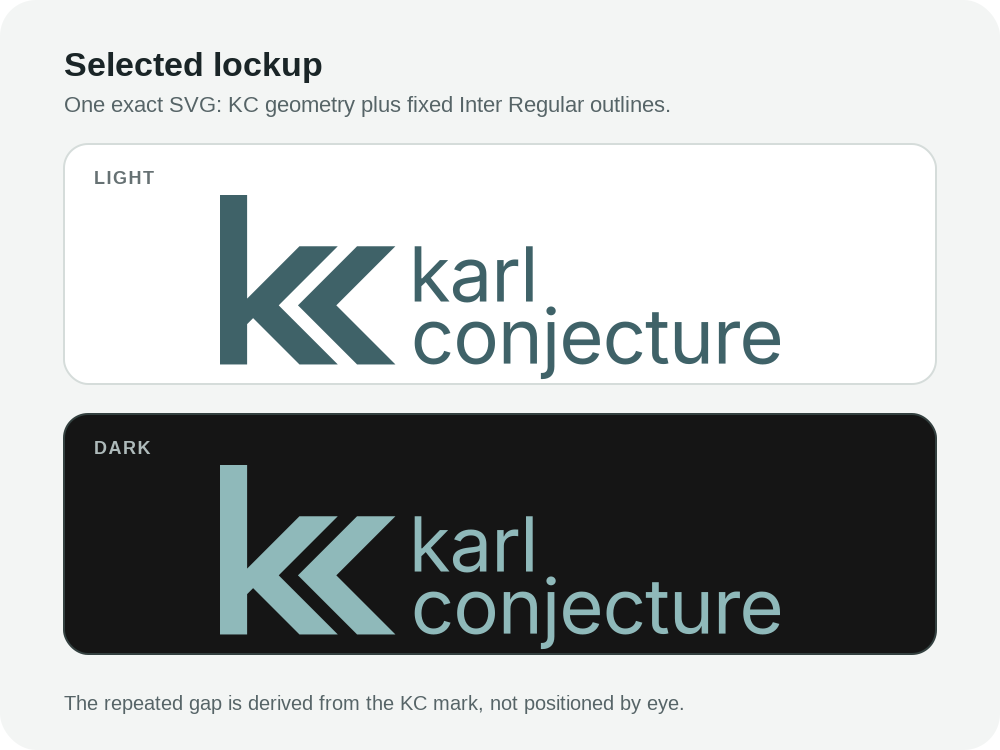
This explanatory figure places the generated lockup on light and dark surfaces.
I started by asking AI to help me brainstorm a logo for Karl Conjecture.
That was useful. The AI and I tried K and C shapes, chevrons, pencils, erasers, discarded ideas, growth, and even restrained wood-grain treatments. Most of them were too literal, too decorative, or too much like a generic startup mark.
One simpler idea survived: a bold K stem, a chevron completing the K, and a matching chevron beside it that reads as the C. The letters would remain separate, use one color, and work on a website, hat, phone screen, sign, or app icon.
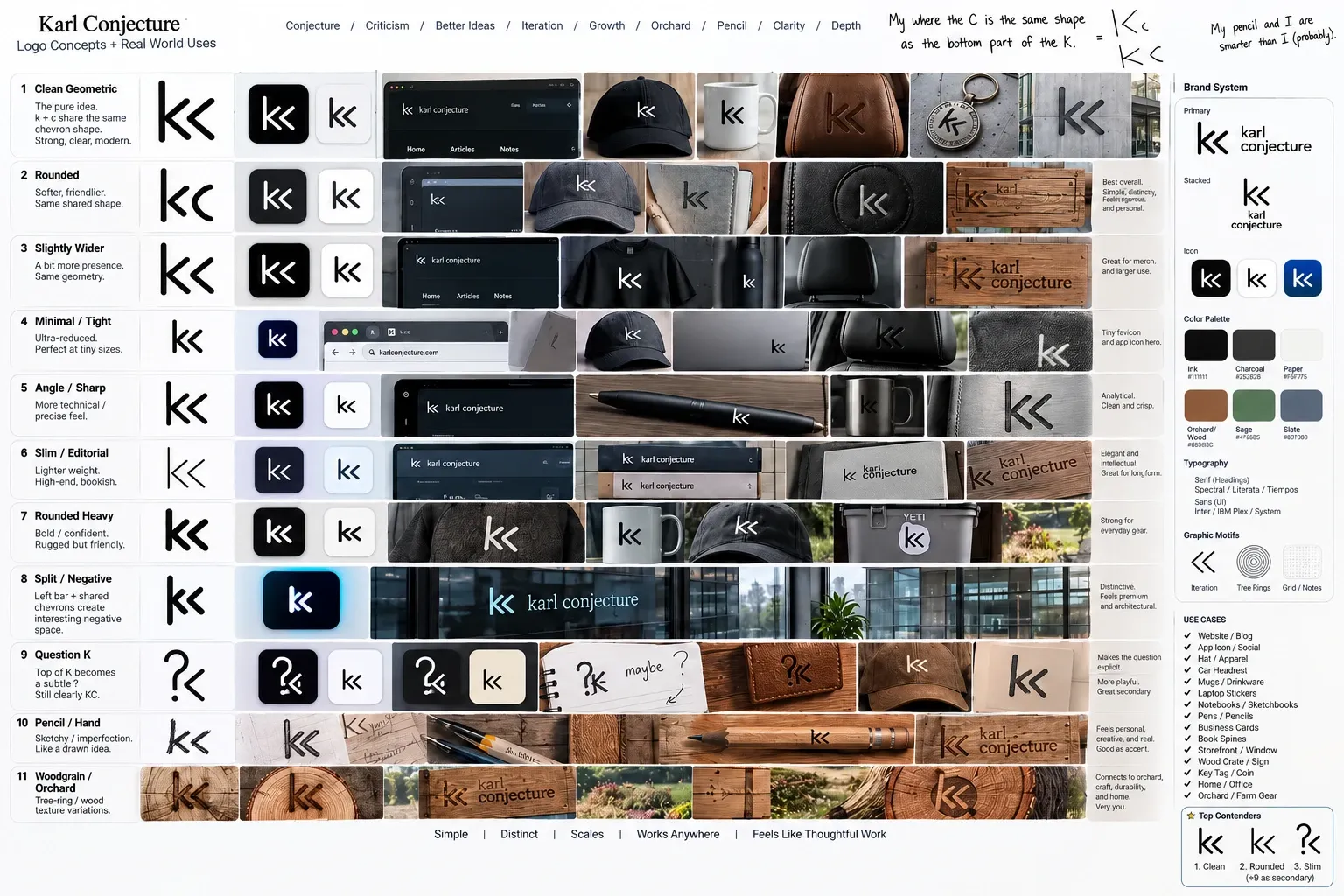
The exploration board records rejected ideas and AI-generated rough mockups. It is process evidence, not a brand guide.
The image generator stopped helping
I would ask to move one corner or reduce the wood grain, and some unrelated part would change. The K and C stopped sharing the same geometry. Line weights shifted. Spacing wandered. A model could understand the general idea without preserving a constrained drawing.
By then I no longer needed more possibilities. I knew which shape I wanted. I needed a precise representation of it.
So I stopped asking AI to draw the final image.
Ten shapes gave me something exact
I recreated the mark in Lucidchart from ten simple black shapes: a rectangle for the K bar, rotated rectangles for the arms, triangles for the terminals, and a small triangle connecting the K chevron to the bar.
The drawing was still assembled by eye, but its exported SVG contained explicit points. That changed the questions I could ask:
- Are these arms really 45 degrees?
- Are the K and C chevrons the same construction?
- Do pieces that meet reuse the same point?
- Are the lower shapes on one baseline?
- Which decimals express a choice, and which came from dragging shapes around?
We preserved that imperfect SVG long enough to distinguish my visual intent from later corrections. Then we normalized the K bar width to 1000 units and changed one relationship at a time.
The strongest rule was simple: a primitive had to remain what it claimed to be. Rectangles kept equal, parallel sides and right angles. Terminal pieces became exact 45-45-90 triangles. Upper and lower arms became reflections. The C became a horizontal translation of the K chevron. Every lower point sat on or above the same y = 0 floor.
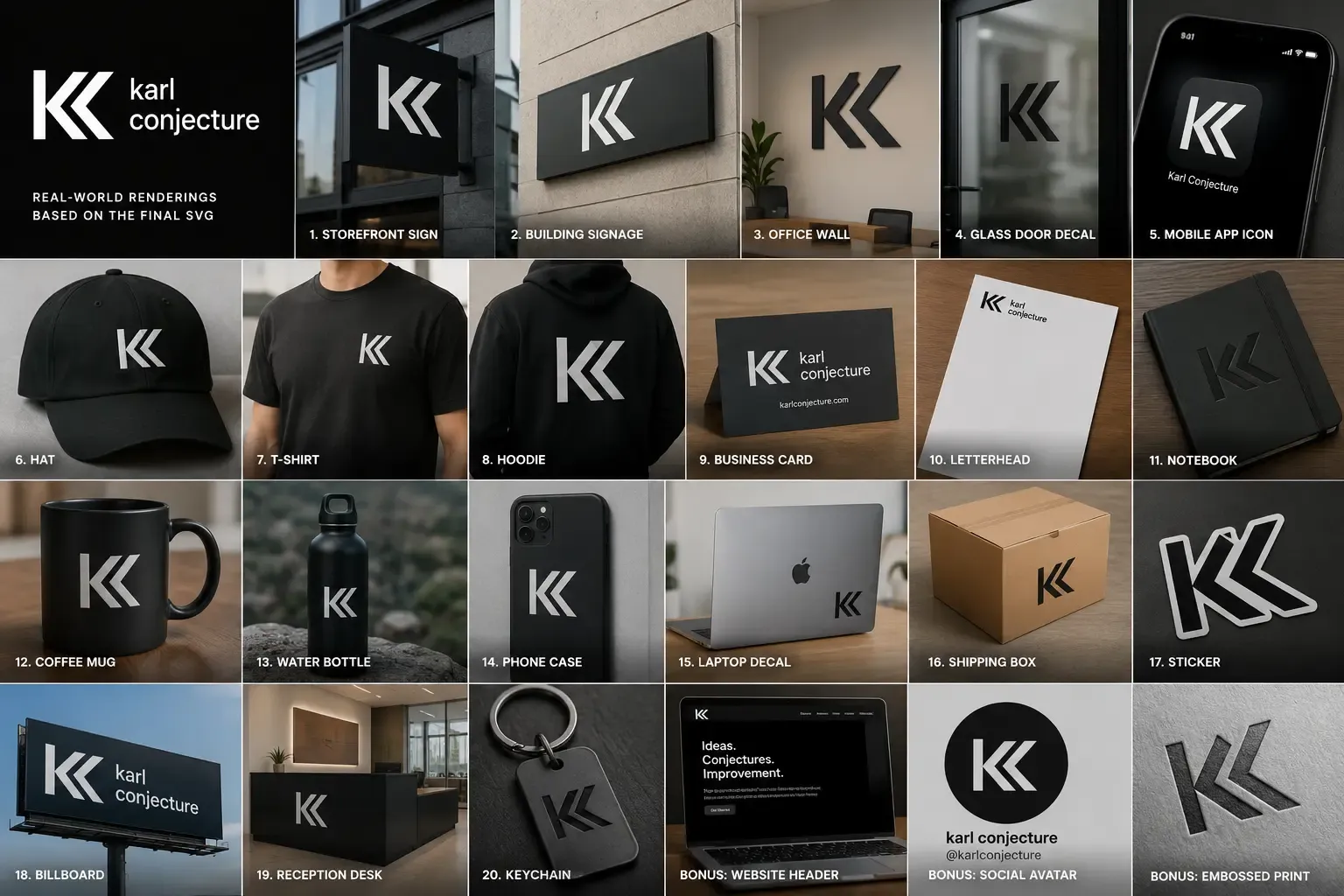
The sheet’s own header says these are real-world renderings of the final SVG. They are AI-generated renders of the first exact version. Testing that version as a real mark exposed relationships worth changing.
The rules became smaller
The first exact version was not the final answer. Once the drawing had coordinates instead of hand-placed points, I could see which measurements were choices and which were leftovers from moving shapes around in Lucidchart.
I kept only the relationships I would want to change deliberately: the height of the mark, the length and thickness of its arms, the small connector inside the K, where the chevrons meet, and the space between the K and C. The code calculates the rest.
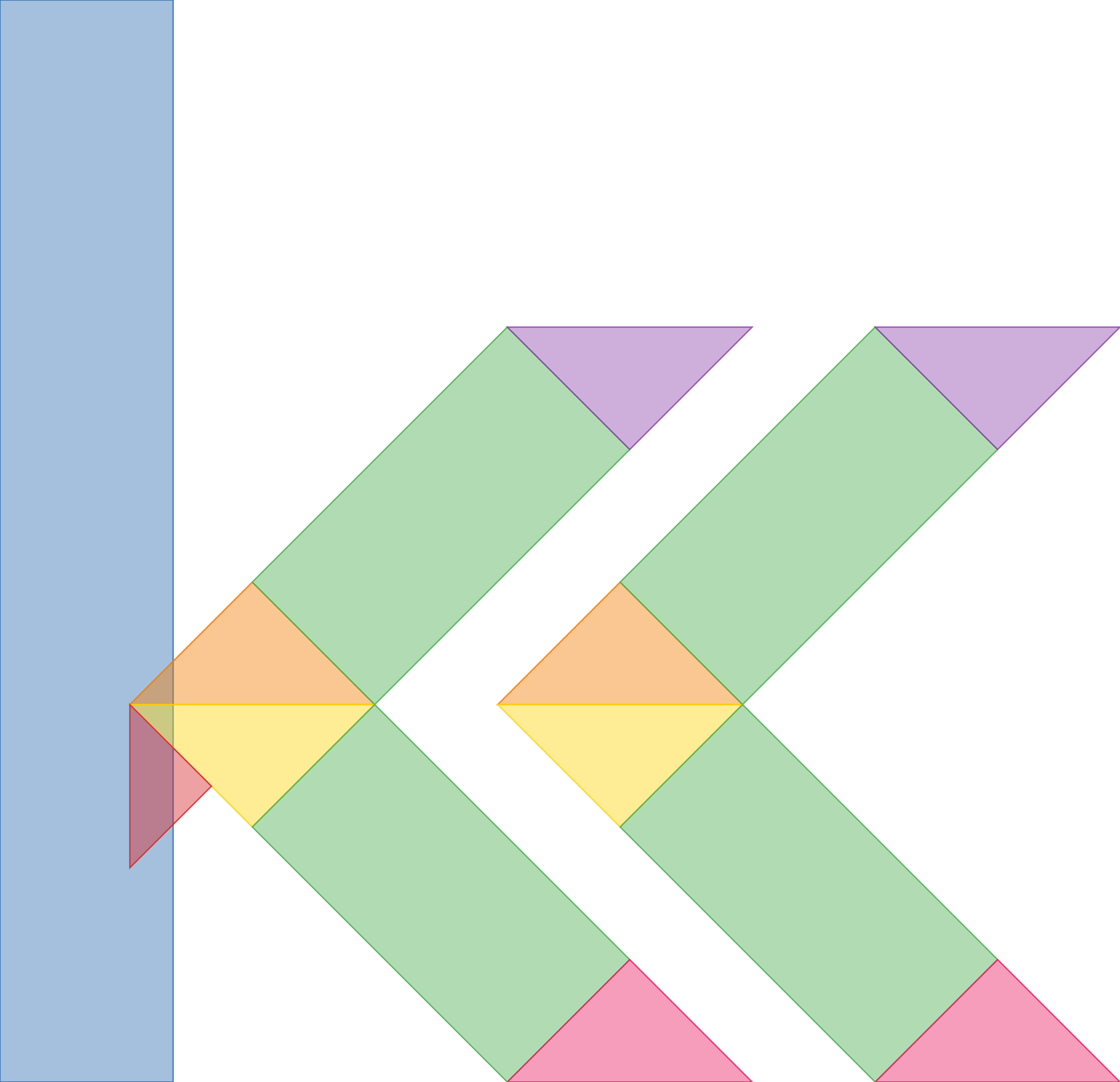
The colors separate the construction pieces so their relationships are easy to inspect. They are not the brand palette.
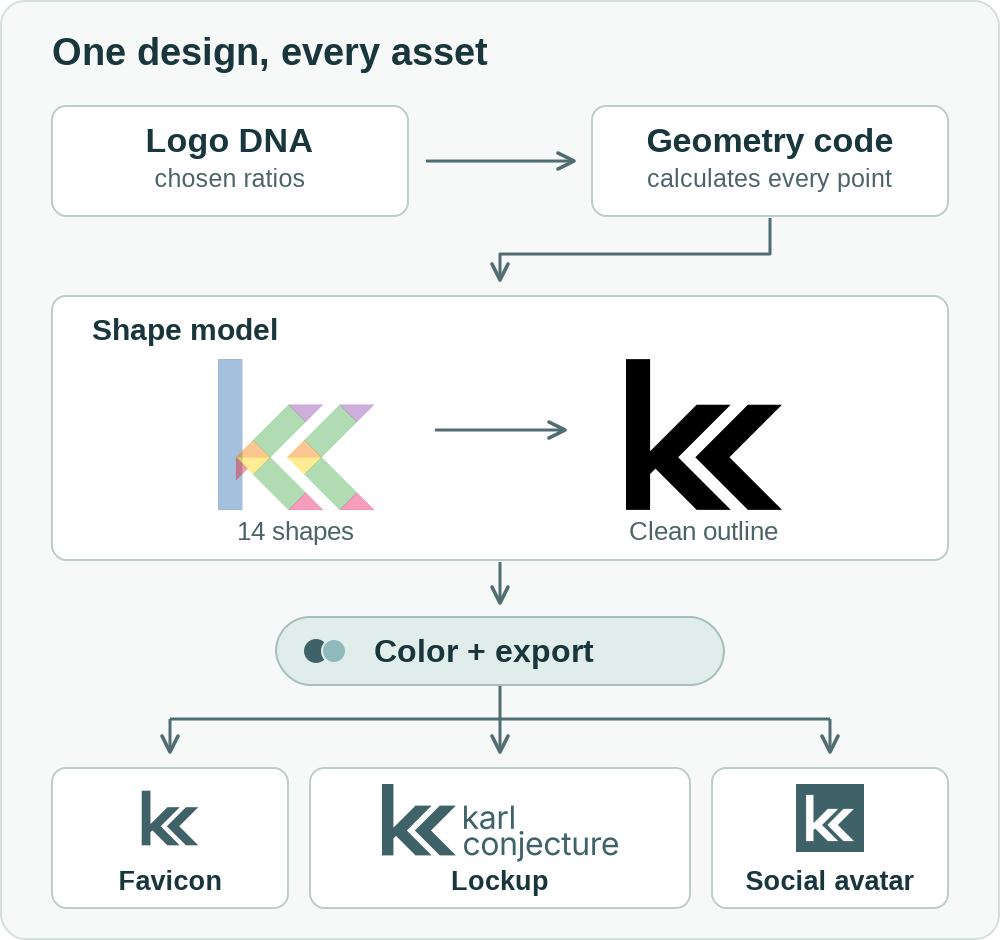
The final construction has fourteen visible pieces: one bar, one connector, and the K and C each have their own arms and terminals (four arms, eight terminals). But I no longer have to position fourteen things independently. If I change one of those few choices, the whole mark rebuilds from the same rules. That was the point where the drawing became a system.
The logo now has tests
I decide whether the mark looks good; tests preserve the geometry and rendering decisions. The repository checks that:
- bar width and arm thickness use the same master unit;
- all four middle arms keep the same shape and size, as do all eight terminal triangles;
- upper and lower chevrons remain reflections;
- the C remains the exact horizontal translation of the K chevron;
- shared junctions do not drift into nearly identical coordinates;
- nothing falls below the common baseline;
- the saved brand SVGs exactly match what the code generates;
- the finished mark is scaled uniformly rather than distorted to fit a container.
If I change a locked ratio on purpose, I update the assertion that locks it, and the other checks tell me whether the rest of the logo still follows these rules.
One model, two useful outputs
Separate filled polygons can show hairline seams at some sizes and zoom levels even when their shared geometry is correct. That is a rasterization artifact, not necessarily a bad joint.
The system therefore generates two representations from the same source:
- a construction SVG with all fourteen primitives visible for inspection;
- a production SVG with one continuous K polygon and one continuous C polygon, eliminating internal paint seams.
The drawing rules, lettering, and colors live in separate source files. Tests regenerate the brand assets and compare them with the saved versions. The diagrams in this article show the version described here.
The lockup uses the same system
The selected lowercase karl / conjecture wordmark uses Inter Regular converted to vector outlines. One generator positions the mark and lettering together. The visible top and bottom align to the C chevron, while the j descender remains below. The horizontal gap repeats the negative space between the K and C, so it scales with the mark instead of drifting independently.
What I like about the result
The process fits the name Karl Conjecture better than a one-prompt success would have.
AI helped generate possibilities. I rejected most of them. When the surviving idea needed precision, I changed tools and supplied a better representation. We found accidental details, replaced them with explicit relationships, tested those relationships, and kept criticizing the result.
The general principle here is to not use a probabilistic tool for a deterministic job. It takes judgment to know when to stop using generative AI to directly create the output, versus using AI to create the process that reproducibly creates the output.